
Proper Forklift Battery Maintenance: The Key to Battery Longevity and Performance
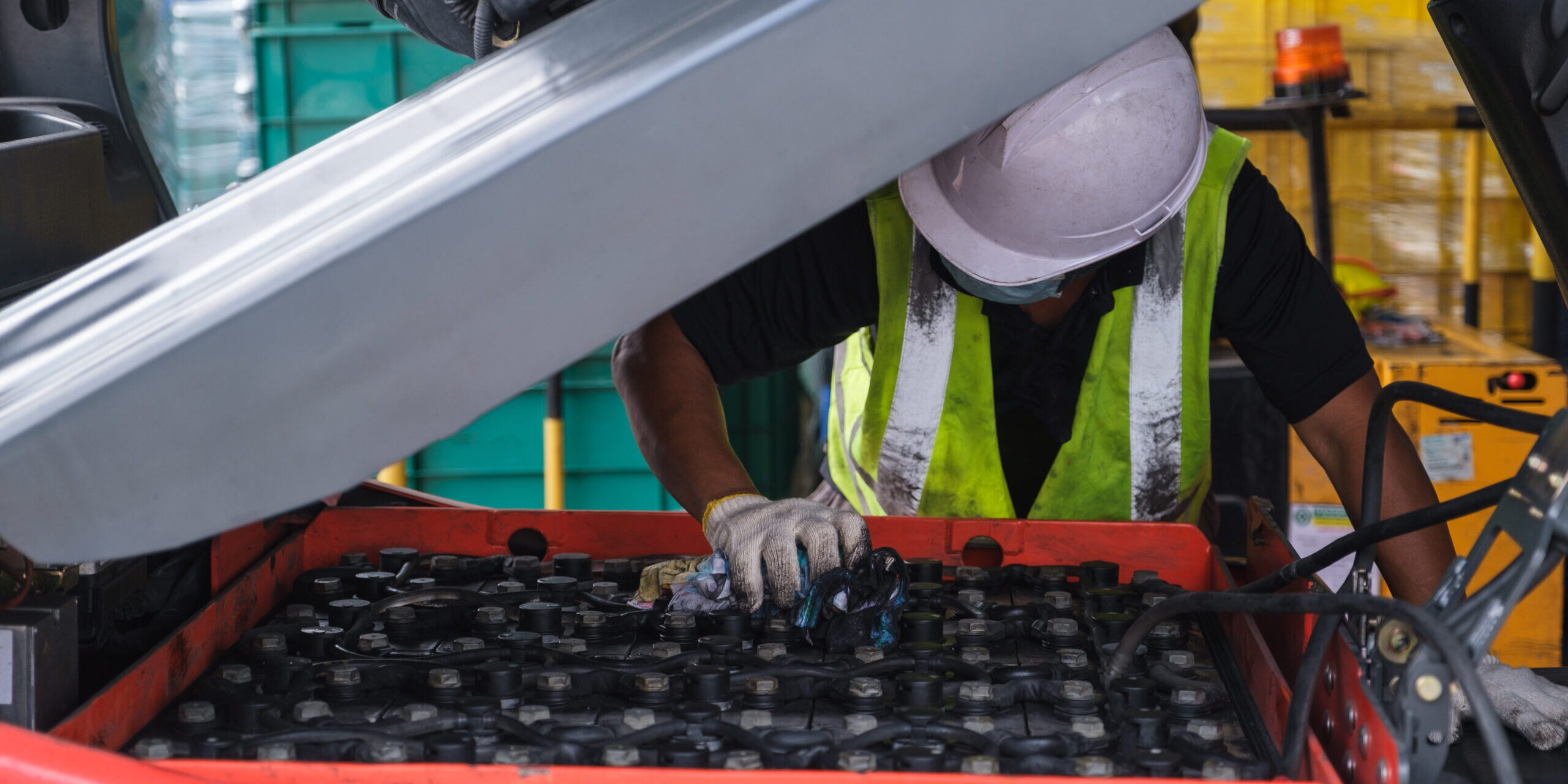
Five Elements of a Successful Forklift Battery Maintenance Program
The battery is the beating heart of your forklift. It’s the most expensive component and the one that requires the most care. Mistreat your battery and it’ll cost you in terms of costly downtime, poor performance, and shorter battery life. Do the right thing by setting up a thorough forklift battery maintenance and care program… and following through with it, and watch your productivity and forklift fleet performance soar.
Your forklift battery maintenance program should be part of your overall forklift maintenance program. Brakes, tires, and mechanical, hydraulic, and safety components need to be maintained on a scheduled basis–as well as the battery and the electrical system. It’s important to realize that problems in other areas of your forklift can result in reduced battery life. In this blog, we’ll just focus on the battery.
1. Use The Proper Battery
Forklift batteries come in a variety of sizes, capacities, and weights.
- Make sure your forklift’s battery has the capacity to accomplish the lifting and transporting tasks it’s being asked to do. Ensure that you’re using a battery with the right voltage and amperage rating.
- Batteries provide ballast to accomplish lifting tasks of heavy loads. Check the forklift manufacturer’s specs to make sure you use a battery that has the power and heft to do what it’s being asked to do.
2. Respect the Charging Cycle
Charging a forklift battery is more complicated than just plugging it in. Here is what you need to know to power up!
- To obtain the longest life from a lead-acid battery, you need to follow the 8-8-8 rule. Use the forklift for eight hours, charge the battery for eight hours, and let it cool down for eight hours.
- You should only charge a battery once it’s dipped below 20% or 30% capacity. If your forklift is exhibiting reduced performance, swap the spent battery out for a charged one. Don’t charge it to greater than 80% or 90%. It could overheat the battery and cause damage. Check the battery manufacturer’s specs for the correct charging levels.
- Check electrolyte levels after cooldown and top up with distilled or de-ionized water as needed. It is critical to wait until the charging process is finished and the battery has cooled—typically at least four hours—before adding water. Doing so too soon, while the battery is still hot, can cause it to boil, damaging the internal cells, reducing its power output, and greatly shortening its overall lifespan.
- Use the correct charger. Forklift chargers have different capacities. Be sure your battery and charger are a match.
- Opportunity charging or fast charging of a lead-acid battery is possible but shortens the battery’s lifespan.
- Practice safe charging. Your facility should have a dedicated charging area that is clean, well-ventilated, and equipped with safety equipment like eye-wash stations, drains, and wash-down hoses for spills. Use personal protective equipment like gloves, goggles, and acid-resistant aprons during charging.
3. Make Battery Inspection Part of Your Daily Forklift Checklist
Inspecting the battery should be part of your daily–or per shift–inspection of all operating elements of your forklift
- Check electrolyte levels and top up with distilled or deionized water as needed —
- Inspect batteries for leaks, cracks, or damage. Swap out a battery that appears to be damaged.
- Inspect cables and connections for corrosion, fraying, or burnt insulation. Replace as necessary.
4. Practice Safe Storage
An important aspect of proper forklift battery maintenance is how you store your equipment. Use these tips to maximize the lifespan of your batteries.
- The ideal temperature for storing forklift batteries is 65 to 70 degrees.
- Your storage area should be well-ventilated to prevent the build-up of explosive or corrosive gases.
- Your designated battery storage area should allow easy removal and replacement of forklift batteries.
- Avoid storing depleted batteries as it can damage them. Always fully charge batteries before storing.
- Observe safety precautions. Lead-acid forklift batteries are very heavy objects filled with corrosive liquids that give off toxic gases. Use proper equipment when removing or reinstalling batteries.
5. Training is Important

Well-trained, knowledgeable personnel will always give you the most productive facility.
- Train forklift operators to inspect forklifts thoroughly and perform essential maintenance tasks.
- Train maintenance personnel thoroughly in forklift maintenance, with a focus on forklift battery care.
- Charging and battery room technicians must understand proper charging and storage protocols.
- Safety First! All staff members should be well-versed in the safe operation of forklifts and battery management.
Do Forklift Battery Maintenance Right — Let The Experts Handle It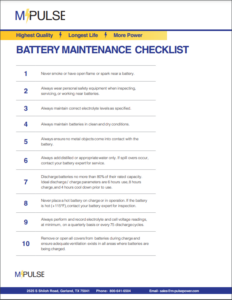
M-Pulse is your full-service, coast-to-coast forklift battery resource. We offer a wide variety of new and reconditioned forklift batteries and US-made chargers at the best price and in a flash! Ask about our Quick-Ship Program! Our nationwide technician squad can provide you with a range of battery services to keep your forklift fleet operating at top efficiency. These include:
- Battery installation, diagnosis, reconditioning, and replacement
- Charger maintenance, repair, and replacement
- Spent battery disposal services
- Staff training and consultation
Contact M-Pulse today for prompt expert support.
Download our Forklift Battery Maintenance Checklist for quick reference!