
Forklift Maintenance vs. Repair: How to Avoid Downtime
Why a Maintenance Plan Beats a Repair Bill Every Time
Taking care of a forklift is a lot like taking care of your car. You don’t wait for the engine to give out before changing the oil, right?
The same logic applies to your warehouse. Stay on top of the small stuff, and you’ll avoid big, costly repairs later on. Managing routine checkups keeps your operation running smoothly, your people safe, and your bottom line protected.
In this article, we’ll break down the essentials of forklift maintenance and help you figure out exactly when it’s time to call for backup.
What Is Preventative Forklift Maintenance?
Think of preventative maintenance as a regular checkup. Instead of waiting for a breakdown, you catch the small cracks early.
At its core, preventative maintenance is about extending the life of your forklifts and keeping your operation moving.
Whether you’re running one lift truck or a whole fleet, having a solid plan will save you money, nerves, and time.
Here’s what that usually includes:
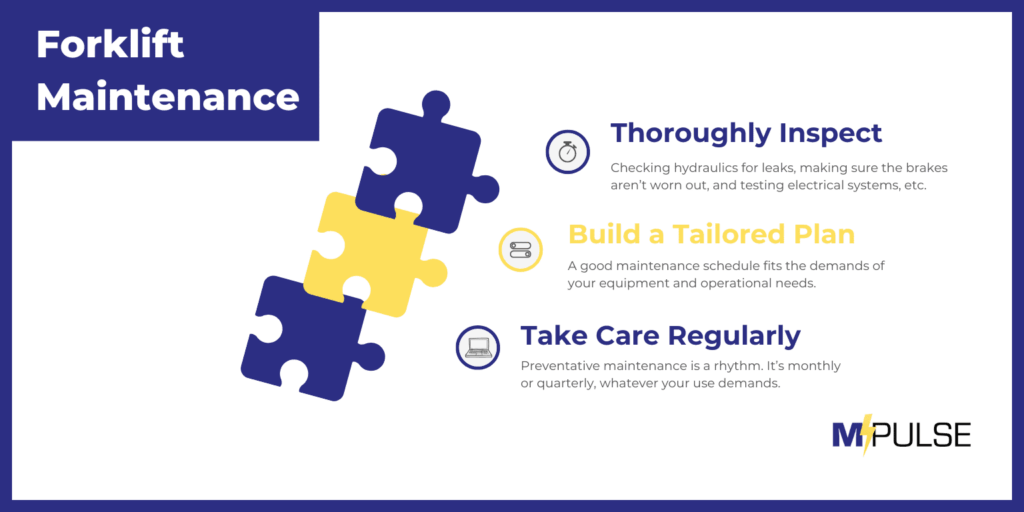
- Thorough inspections: This means checking hydraulics for leaks, making sure the brakes, batteries, and lift mechanisms aren’t worn out, and testing electrical systems to avoid unexpected failures.
- Tailored plans: Not every forklift works the same job. Some are running non-stop in high-heat warehouses, others not as hard. A good maintenance schedule fits the demands of your equipment and operational needs.
- Ongoing care: Preventative maintenance is a rhythm. It’s monthly or quarterly, whatever your use demands. The goal? Fewer surprises, fewer breakdowns, and more control over your schedule.
Why Is Regular Forklift Maintenance So Important?
Sticking to a maintenance schedule helps you stay ahead of problems and avoid bigger issues down the line. Here’s what you gain when you keep your forklifts in top shape:
- You increase the lifespan of your equipment for years
- You reduce surprise breakdowns and emergency repair costs
- You improve safety for your operators and team
- You keep performance consistent — smooth lifts, steady brakes
- You lower the total cost of ownership over time
- You avoid downtime that slows down your operation
- You boost resale value with a solid maintenance history
- You stay compliant with safety standards and inspections
Bottom line, preventative maintenance gives you peace of mind. You know your forklifts are reliable, and that helps everything else run smoother, too.
7 Critical Things Your Lift Maintenance Should Include
Beyond the basics, a complete maintenance program covers a few more essential tasks that keep your fleet running longer, safer, and more efficiently.
Here’s the list of items that every responsible forklift maintenance and repair company would want you to hang on the wall:
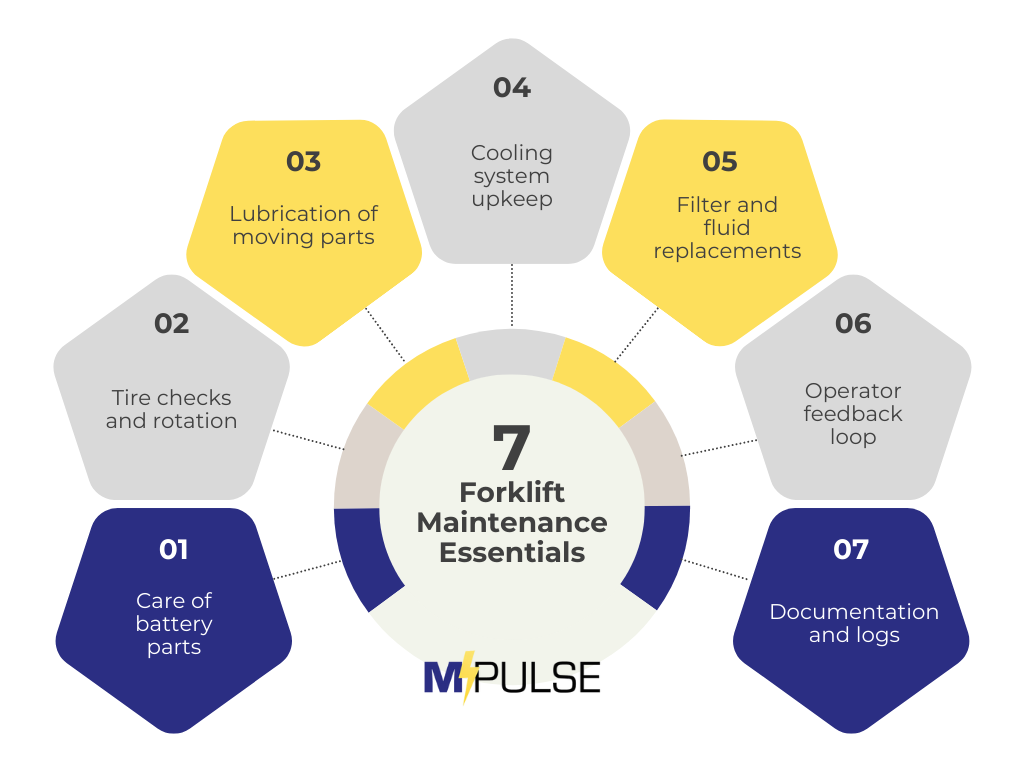
- Care of battery parts: Clean terminals, proper water levels, and healthy connectors help you avoid battery damage and keep your forklift running at full power.
- Tire checks and rotation: Bald or damaged tires affect stability and safety. Regular checks prevent uneven wear and reduce the risk of accidents.
- Lubrication of moving parts: Chains, mast rollers, and other joints need proper greasing to reduce friction and extend part life.
- Cooling system upkeep: If you run internal combustion forklifts, radiator flushes and hose inspections help prevent overheating, especially in high-temperature or dusty environments.
- Filter and fluid replacements: Engine oil, transmission fluid, hydraulic fluid, and air filters all need replacing on a schedule to prevent system damage.
- Operator feedback loop: Encourage operators to report unusual noises, smells, or behavior. They’re the first to notice when something’s off.
- Documentation and logs: Keeping accurate maintenance records ensures nothing gets skipped and helps track patterns over time. It’s also a must for safety audits.
Regular maintenance isn’t just about reacting to problems. It’s about preventing them entirely. Cover these bases, and your fleet stays stronger, longer.
How to Recognize When Repairs Are Needed
Even with a solid maintenance routine, forklifts will wear down over time. The trick is knowing when it’s gone beyond regular upkeep and when you need to call in a professional.
Here are the most common signs that a repair is needed:
- Strange noises during operation
Grinding, squealing, hissing, or any unfamiliar sound is a red flag. These noises usually mean something’s under strain or about to fail. - Sluggish performance or reduced lift capacity
If the forklift feels underpowered, moves slower, or struggles to lift loads it normally handles with ease, there may be a hydraulic or drivetrain issue. - Visible leaks or signs of damage
Fluid on the floor, cracked hoses, loose chains, or bent forks are all signs that a forklift may need closer inspection. - Warning lights or fault codes
Most modern forklifts display error codes or dashboard lights when something’s off. If those lights stay on, it’s time to stop and investigate. - Braking or steering issues
If your forklift doesn’t stop as it should or the steering feels loose or unresponsive, it’s not just a performance issue. It’s a safety issue. - Battery or charger problems
If the forklift isn’t holding a charge or the battery charger is shutting off or overheating, the issue may go beyond the battery. Faulty connectors, damaged wiring, or charger failure could be to blame.
If Operators Say, “Something Feels Off,” Listen!
Yes, you should know about the technical details above. However, the problem isn’t spotting the issue — it’s not acting on it.
Therefore, a pro tip: If your operators say, “Something feels off,” open your ears. It’s easy to get busy, but acting early when something feels off can save time and trouble later.
Forklifts are tactile machines. Operators who use them daily often notice subtle changes long before something officially fails.
When to Call Forklift Repair Professionals

Even with a solid in-house team, there are times when calling a professional forklift repair service is a must.
If you’re dealing with electrical issues beyond a blown fuse, error codes that won’t clear, or complex mechanical problems, especially with hydraulics or the control system, it’s time for expert help.
After a collision, even if damage isn’t visible, a technician should inspect the lift. It’s always best to pause and have a technician take a closer look before returning a forklift to service. Plus, sometimes, despite regular maintenance, a unit just isn’t performing right. That’s when a full diagnostic is worth it.
Certified technicians know what to look for. They use genuine parts and follow manufacturer standards. They have access to diagnostic tools that go beyond visual checks. When they fix something, it stays fixed.
So, if something feels off, don’t guess. Get it checked by someone who knows forklifts inside and out. It’s safer, smarter, and often cheaper in the long run.
Special Focus: Don’t Forget Forklift Battery Maintenance
Your forklift is only as strong as its power source. While a lot of folks stay on top of mechanical maintenance, proper forklift battery maintenance is one of the most overlooked areas.
Common Battery Issues That Need Attention
- Corrosion buildup on terminals or cables can block electrical flow and reduce charging efficiency.
- Decreased charge capacity, where the forklift runs out of power faster or doesn’t hold a full charge.
- Physical damage like cracks, bulging, or leaking acid from the casing. These are major safety risks.
- Swollen or warped battery cells can indicate overcharging or internal heat damage.
- Burnt smells or discoloration around the connectors, or case may signal overheating or internal short circuits.
Preventative Steps To Extend Battery Life
1. Clean and inspect regularly: Remove corrosion, check for loose or frayed cables, and ensure tight terminal connections.
2. Water properly: Check fluid levels weekly and top off after charging using distilled water (never overfill). Check our Forklift Battery Watering Guide or head straight to Battery Watering Checklist to get an idea of how to do this correctly.
3. Follow correct charging protocols: Stick to full charge cycles, avoid frequent plug-ins and mid-shift charging unless the battery system is designed for it.
4. Use the right charger: Always match the forklift battery charger to the battery type, voltage, and amp-hour rating. Make sure they are quality chargers, and feel free to check M-Pulse’s High-frequency Battery Chargers if you need new ones. If you’re a Grocery & Food Service, this is how you choose your Forklift Battery Chargers.
5. Allow cooldown periods: Don’t charge batteries immediately after use. They should cool down first to prevent internal damage.
6. Keep battery compartments ventilated: Charging releases gases that need airflow to dissipate safely. If something seems off with battery performance, get it checked out before it turns into a bigger issue.
Why Choose M-Pulse for Forklift Battery Repair
 As you probably got the idea, preventive maintenance and forklift battery service are very important.
Our factory-trained technicians handle mechanical and electrical battery issues. We provide nationwide service with fully stocked service vans to complete most repairs on-site.
We offer routine battery watering, reconditioning, and full replacement options when needed. We also ensure proper disposal, following environmental regulations to the letter.
We understand that every operation is different. That’s why we tailor our service plans around your workload, usage patterns, and fleet size. With transparent pricing and a strong focus on minimizing downtime, we treat your business as our own.
Here’s what you can expect from us:
- Fast, nationwide on-site repairs with 24/7 support
- Technicians skilled in both mechanical and electrical battery systems
- Expert maintenance: watering, reconditioning, replacements, and disposal
- Tailored service plans that fit your operation and budget
- A clear focus on uptime, efficiency, and long-term performance
Reach out today or download this Forklift Battery Maintenance Checklist to take action ASAP! We’re ready when you are.
Maintain, Then Repair When Needed.
We may sound like a broken record, but it’s worth repeating: the forklifts that get regular attention are the ones that stay reliable.
Don’t sweat it; you don’t need to do everything perfectly. Just motivate the right people to stay consistent, catch issues early, and know when it’s time to call in a professional.
If you can’t handle it in-house, outsource your preventative maintenance. M-Pulse has the team to keep your operations running smoothly.
Your forklifts do the heavy lifting every day. Let’s give them the care they deserve.